

Mission Overview・Mission Flow
Mission Overview
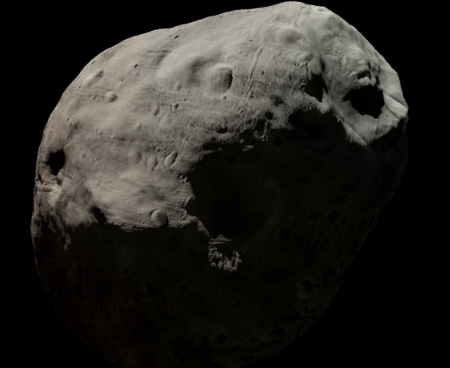
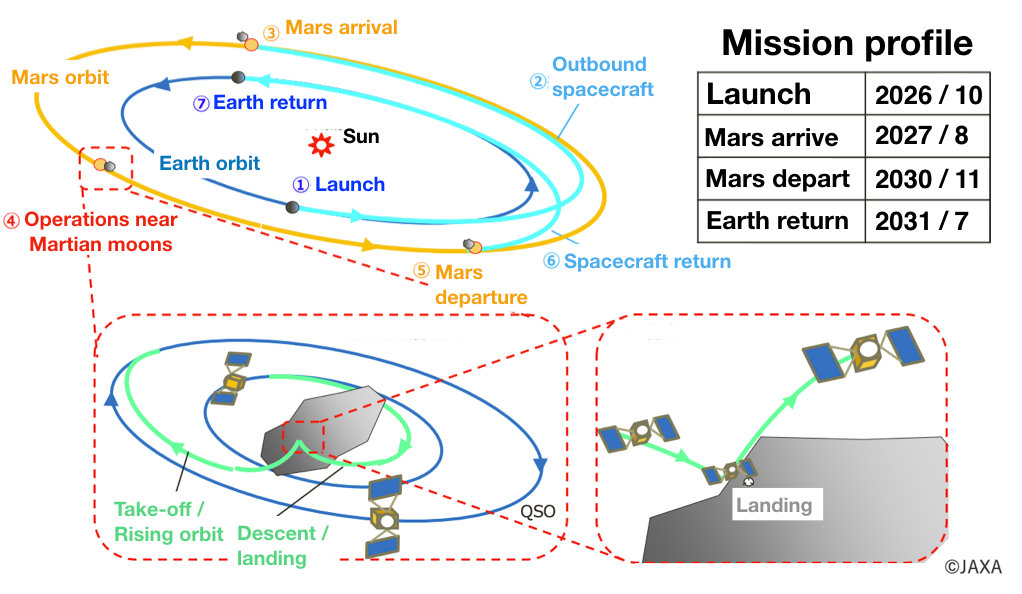
Like the Hayabusa2 mission, which explored and returned samples from an asteroid, MMX will investigate the Martian moons and return a sample from Phobos to Earth. The mission is scheduled for launch in JFY 2026, followed by an approximately five year journey for the round-trip to the Martian sphere and exploration of the system. MMX aims to collect more than 10g of material from Phobos, making this the world's first sample return mission from the Mars region.
Mission Flow
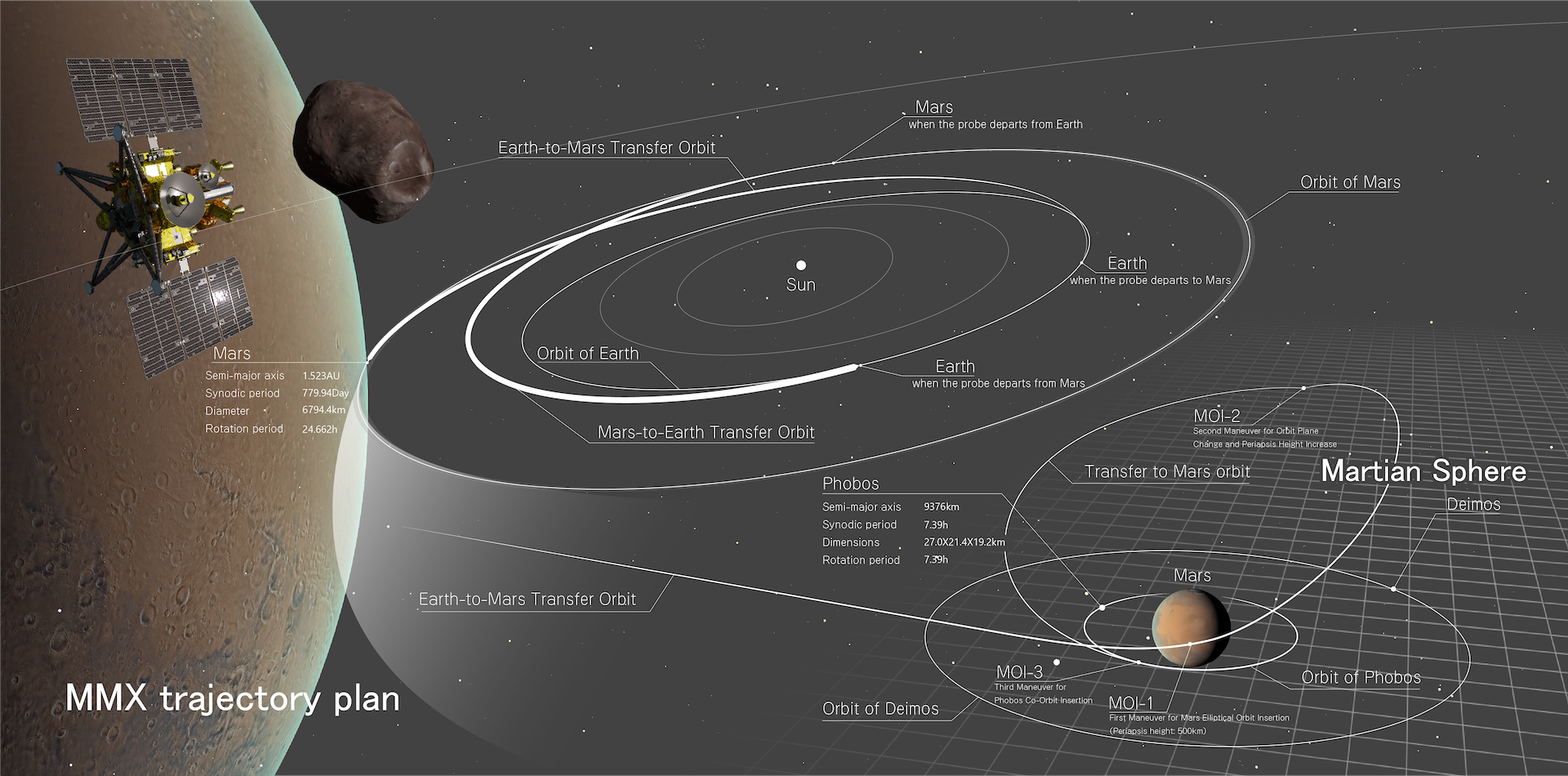
About one year after launch, the MMX spacecraft will arrive at Mars. After that, MMX will enter an orbit (Quasi-Stationary Orbit: QSO) around the Martian moon, Phobos, and perform a series of observations. The period remaining in the vicinity of the Martian moon will be decided during on-going studies, such as observational planning. After observations and sample collection, MMX will return to the Earth after a journey of about one year and deliver the collected samples home.
Mission Objective
The MMX mission has the following objectives defined based on two different aspects: science and engineering.
Science
- Clarification of the origin of the Martian moons and the process of planet formation in the Solar System.
- Clarification of the evolution process of the Martian-sphere (Mars, Phobos, Deimos).
Engineering
- Establish the technology required for the return trip between the Earth and Mars.
- Establish advanced sampling techniques on celestial bodies.
- Establish optimal communication technologies using a newly developed ground station.
Expected Outcomes
Understanding how Mars and the two moons formed is a heavily debated topic in Solar System science. Remote-sensing observations by the MMX spacecraft and the detailed analyses of the returned sample will determine whether Phobos and Deimos are remnants of early Mars created from debris produced by a giant impact with the young planet, or whether the moons are asteroids captured by Mars's gravity that brought material from outer Solar System.
Observations of the Martian atmosphere and the space environment surrounding the moons will clarify how atmospheric material circulates and escapes into space, providing insights into the processes that shaped Mars's long-term evolution.
Together, these results will tackle one of the central questions in planetary science: how environments capable of supporting the prebiotic chemistry necessary for the emergence and persistence of habitable conditions arose in the Solar System.
Explanation of the spacecraft

Mission Subsystem
The various different instruments to measure scientific data.
Data handling Subsystem
The data obtained from mission instruments and the spacecraft bus system is processed here to transmit to Earth. At the same time, data that cannot be downlinked is recorded in the Retrive Data Recorder (RDR) installed on the Sample Return Capsule.
Electrical Power Subsystem
Generates, stores, and provides electrical power to the whole spacecraft.
Guidance, Navigation and Control Subsystem
Controls the attitude of the spacecraft and maintains knowledge of where the spacecraft is located.
Attitude and Orbit Control Subsystem
By using sensors and actuators such as thrusters and gyroscopes, this controls the spacecraft’s orbit and attitude.
Landing Subsystem
Consists of the landing gear and all other necessary devices to land the Martin moon surface safely.
Thermal Control Subsystem
Maintains thermal conditions for all devices and instruments.
Communication Subsystem
Provides communication functions between spacecraft and the control center.
Structure Subsystem
Provides structural support to the propulsion module, exploration module, return module, and all onboard devices and instruments.
Propulsion Subsystem
Responsible for the chemical propulsion system used to accelerate, deaccelerate and control attitude.
Sampler
Sampler : collects samples from the Martian moon.
Sample Return Capsule: responsible for bringing samples taken from the Martian moon safely back to the Earth.
Ground System
Consists of ground facilities such as antennas to operate the spacecraft via sending commands and receiving measurement data.